


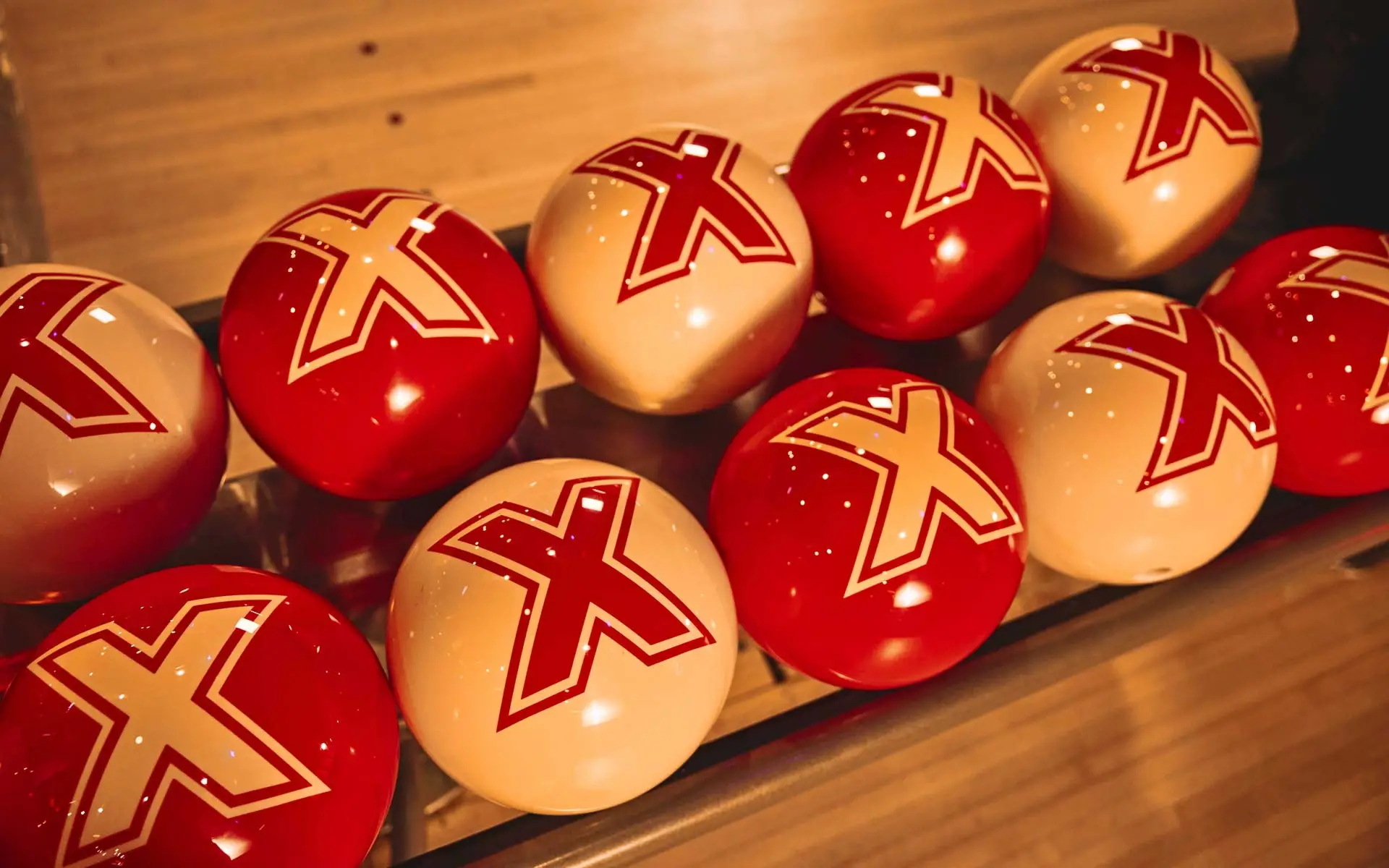
A timeless game with modern energy
Bowling isn’t just a game, it’s a cultural time capsule. With a past that spans continents and millennia, it’s transformed from sacred rituals to televised fame, and now lives on in upscale, high-vibe experiences like Lucky Strike. Whether you're chasing a strike with friends, sipping an espresso martini, or diving into our immersive arcades, you’re taking part in a tradition that’s as enduring as it is electrifying.
While the pins have changed and the lights are brighter, one thing remains true: bowling brings people together. And to truly appreciate the elevated energy of today’s lanes, it’s worth taking a look at where it all began.
Bowling’s ancient origins
Long before LED lanes and signature cocktails, bowling began in the most unexpected places. In the 1930s, British anthropologist Sir Flinders Petrie discovered a child's grave in Egypt dated to around 3200 BC. Inside were stone pins and a ball, evidence that some version of bowling existed over 5,000 years ago.
In ancient Polynesia, a game called ula maika challenged players to roll stone balls down a lane 60 feet long to strike a target. That same distance, 60 feet from foul line to head pin, is still standard in tenpin bowling today.
Meanwhile, early Germanic tribes practiced a form of the game as a religious ritual around 300 AD. Rolling stones at club-shaped “kegels” was meant to cleanse the soul of sin³. Centuries later, Martin Luther reportedly standardized the game to nine pins, a format that would influence bowling for generations.
Bowling comes to America
As settlers from Germany, England, and the Netherlands arrived in the New World, they brought their versions of the game with them. Bowling showed up in early American literature, notably in Washington Irving’s Rip Van Winkle, where the thunderous sound of “crashing ninepins” sets an eerie mood.
In New York City, a stretch of land known as Bowling Green became one of the first documented bowling locations in America. But the game’s widespread popularity had a downside, by 1841, ninepin bowling was outlawed in Connecticut due to its association with gambling. To get around the ban, players simply added an extra pin. And so, tenpin bowling, America’s favorite format, was born.
Standardizing the strike
By the late 1800s, bowling was booming across the U.S., but without consistent rules, playing the game could vary wildly from city to city. Everything from pin size to ball weight was different, making competition uneven.
That changed on September 9, 1895, when representatives from regional bowling clubs gathered at Beethoven Hall in New York City. Led by restaurateur Joe Thum, the meeting resulted in the founding of the American Bowling Congress (ABC), which began standardizing rules and certifying equipment and lanes. This was the moment bowling transformed from a casual pastime into a regulated sport.
Women, however, weren’t officially included, yet they were already organizing and competing informally as early as the 1880s¹. In 1917, a group of trailblazing women in St. Louis formed what would become the Women’s International Bowling Congress (WIBC). Their mission: to bring uniform rules to women’s leagues and create national competitions.
Over the years, the WIBC grew into the largest women’s sports organization in the world, with over 1.2 million members and more than 60,000 sanctioned leagues. It marked a turning point not only in bowling but in women’s sports as a whole.
Equipment that changed the game
While the rules were evolving, so was the gear.
In 1905, the first rubber bowling ball, called the Evertrue, entered the market, offering players more control and consistency. It was followed in 1914 by Brunswick’s Mineralite ball, made from a then-mysterious rubber compound that helped shape the future of ball design.
But perhaps the most dramatic shift came in the early 1950s with the invention of the automatic pinsetter. Patented by Gottfried Schmidt and acquired by AMF, the first commercial versions launched in 1951–1952. This innovation eliminated the need for human “pinboys” and made bowling alleys more efficient, and more appealing to a broader public.
These advancements paved the way for bowling to become not just a recreational activity, but a competitive sport with national leagues, televised games, and massive popularity.
Bowling on the big screen
In the golden age of American television, bowling found its spotlight.
NBC’s Championship Bowling was the first nationally broadcast bowling series, captivating audiences and elevating the sport's mainstream appeal. It wasn’t long before shows like Bowling for Dollars, Make That Spare, and Celebrity Bowling brought the sport into living rooms across the country.
In 1961, the Professional Bowlers Association (PBA) partnered with ABC to televise matches, helping turn league players into household names. Promoter Eddie Elias, a key figure in the PBA’s rise, knew that television was the ultimate game-changer.
Women also claimed screen time through the Ladies Pro Bowlers Tour, which later evolved into the Professional Women’s Bowling Association (PWBA). With both men’s and women’s leagues gaining visibility, bowling’s golden age on screen had officially begun.
Bowling goes global
From ancient tombs to prime-time TV, bowling has rolled its way around the world. Today, it’s played in more than 90 countries by an estimated 95 million people. Whether it’s competitive leagues in Tokyo, family outings in Toronto, or late-night showdowns in Los Angeles, bowling continues to unite people across cultures and generations.
Much of that global expansion is supported by the Fédération Internationale des Quilleurs (FIQ), which oversees international competitions across Olympic zones. These tournaments spotlight the best of the best and highlight just how far the game has come from its ninepin roots in medieval Europe.
Lucky Strike proudly reflects this global love for the game, infused with its own elevated twist. It’s where the thrill of the sport meets curated cocktails, gourmet bites, and an atmosphere that’s anything but ordinary.
A legacy that keeps rolling
What started as a spiritual ritual and backyard pastime has become a worldwide movement, evolving through centuries, revolutions, and radical innovation. Bowling has survived bans, embraced automation, starred on TV, and empowered generations of players across the gender spectrum.
And now? It’s having a moment again, revitalized in part by immersive, design-forward venues like Lucky Strike that transform the game into a full-on experience. Here, the legacy of bowling isn’t behind us, it’s alive in every strike, every celebration, and every night spent under neon lights.
Step into the next chapter at Lucky Strike
Bowling’s story spans millennia, and its next chapter is yours to write. Whether you’re chasing your first spare, throwing a perfect game, or just showing off your style between sips of a mango margarita, you’re playing a role in something timeless.
Ready to roll? Book your lane at Lucky Strike and experience the legacy, in luxe, unforgettable style.